In England
In China
I suppose one solution would be to require papers to be handwritten.
Thursday, June 22, 2006


Proper Matter
Are women and gays proper matter for ordination?
A Times (London), June 22, 2006, correspondent digs up an interesting verse:
A Times (London), June 22, 2006, correspondent digs up an interesting verse:
God instructed Moses to tell Aaron: “No man among your descendants for all time who has any physical defect is to come and present the food of his God. No man with a defect is to come, whether a blind man, a lame man, a man stunted or overgrown, a man deformed in foot or hand, or with misshapen brows or a film over his eye or a discharge from it, a man who has a scab or eruption or has had a testicle ruptured.”
I bet there is a bishop or two in the Anglican Communion with misshapen brows or filmy eyes.
Who Won the War?
Josh Marshall pulls up a survey of polls about public opinion in the US during WWII as part of a discussion about the current publics "failure" to maintain support.
The graph is here.
I've never seen it before, but it's very interesting in terms of considering the question who won world War II?
There seems to have been a huge flip in public opinion in November 1942 over whether the war could be won by the allies at all. What caused that flip was the victory of the Red Army at Stalingrad.
Apparently, the Red Army won the war.
Wednesday, June 21, 2006
World Cup Hair
Probably the worst hair in this World Cup belongs to the same person
who had it in the last World Cup, the Argentine midfielder Juan Pablo
Sorin. Our planet has millions of poodles who would come second to
Sorin in a poodle-lookalike competition. This was true four years ago
and it is still true today.
More at the London Review of Books
Gay Episcopalians
Are there any other kind, one might ask some days? Surely the Episcopal Church has some other issues to discuss at its triennial conventions?
On the whole this has been a great week for lesbian and gay people in Mainline American Protestantism. Presbyterians have essentially agreed to allow the ordination of open lesbians and gays, and Episcopalians have both elected a LGBT-friendly female leader and refused to bow to the demands of African bible-thumping conservatives to apologize for consecrating a gay man as a bishop, nor to definitively rule out ordaining another one.
The Episcopalians adopted a last minute resolution that "this Convention therefore call upon Standing Committees and bishops with jurisdiction to exercise restraint by not consenting to the consecration of any candidate to the episcopate whose manner of life presents a challenge to the wider church and will lead to further strains on communion." ...to exercise restraint by not consenting...! This verbiage is hardly an insult to LGBTs, gives the Archbishop of Canterbury some cover, and really does nothing to stop the further gradual acceptance of LGBTs in society and the Church. They seem to have done nothing to stop more dioceses creating commitment ceremonies.
But some LGBT Episcopalians are going ballistic.
I'm a Roman Catholic, and intend to remain one. I think Fr. Jake and some other LGBT commentators seem more than a little bipolar (not in a technical sense) in their responses to the various resolutions.
TEC remains a very welcoming Church for LGBTs in most dioceses (not, however in Jacksonville FL, where I live). The final resolution is clearly a make-nice effort, not a rubbishing of LGBTs, and, if one thinks politically, quite a good way to make sure the breakaways, etc., remain marginalized.
Evil
The news of the killing of two American soldiers was horrible and disturbing [ no man is an island ] in a way I don't recall before. Sinister, and despite what you may read elsewhere, a complete betrayal of Islam.
Having opposed the war to begin with (I thought the US would mess up the aftermath), I still dont think the US should "cut and run," but I think it is increasingly likely that it will. I read in too many places today that this is "a war the US must not loose but cannot win". If that view becomes the concensus, the US public will force a withdrawal.
There is only so much evil people can confront.
A friend who has seen the beheading video of Nick Berg said that he "couldn't get it out of my mind for days....don't watch it...it isn't good to...couldn't get his crying and screaming out of my mind...these people are very sick."
I found that I have become rather Calvinist, or Augustinian, about this. I don't think people who doe this are sick, I thinkthey are evil. But that does not mean incomprehensible: a good follower of St. Augustine and his view of fallen humanity would say that evil is more comprehensible to fallen humankind than good.
I want think that humanity is basically good, but I dont feel like that very much at the moment.
Perhaps western religious thought (Jewish, Christian, and Islamic is simply not adequate to address why people behave evilly. The first words read in a traditional Chinese education (from the Hundred Character Classic) were "Man is Good." Mencius, the second great name of the Confucian tradition noted that when normal people hear a baby cry, they will try to help. He argues that getting people to act evilly is like pushing water up a hill - it can be done, but is not natural.
Rather than just regard these perpetrators of atrocity as evil, perhaps we should regard them as unnatural.
Tuesday, June 20, 2006
Soccer and Religion
The Nike advertisement featuring Wayne Rooney covered in the "Cross St. George" in blood is remarkable.
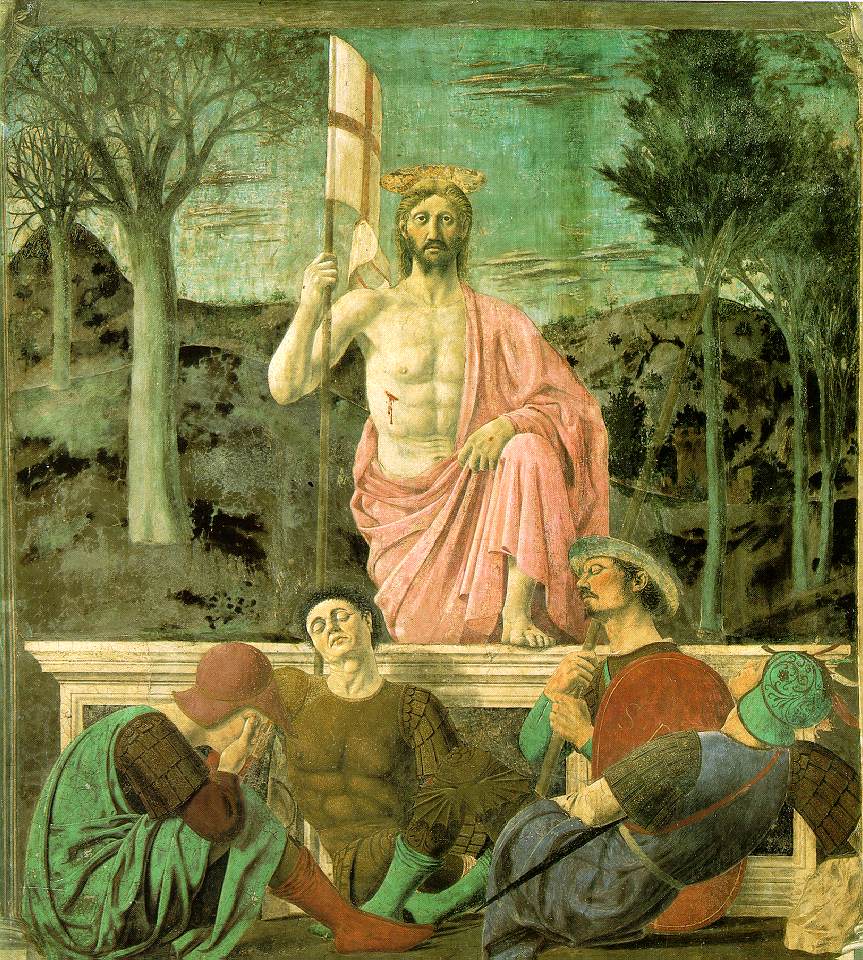
Point of interest: the flag is in fact the "Flag of the Resurrection" (see lots of Byzantine and Medieval images of Christ carrying the flag at the resurrection for example by Piero de la Francesca here). St. George carries it because he is the "champion of Christ" (as in a champion in a tournement). Some Greek texts also have him as the "beloved" and "bridegroom" of Christ.
Point of interest: the flag is in fact the "Flag of the Resurrection" (see lots of Byzantine and Medieval images of Christ carrying the flag at the resurrection for example by Piero de la Francesca here). St. George carries it because he is the "champion of Christ" (as in a champion in a tournement). Some Greek texts also have him as the "beloved" and "bridegroom" of Christ.
The Oldest Country
[From theMEDIEV-L list 6/20/06,
Lynne Puckett wrote:
I think this is true, in a sense (if one excludes Russia from Europe), but I have to say that in terms of the "political present", Americans have a much lengthier sense than the British.
While one might cite Churchill or Attlee (more likely Beveridge), Harold Wilson, or Margaret Thatcher in a political discussion in modern Britain, I don't think anyone would cite as authoritative the opinions of Baldwin or Asquith, never mind the Duke of Wellington or Pitt the Younger. Occasionally, I suppose, the opinions of past political thinkers might be cited, but not without the awareness of a vast difference between when Locke, Smith, and co. lived and the present.
But American political discussion - this in a modern industrial continental world power - is obsessed with the opinions and ideal of rural politicians of the late 18th- and 19th- centuries, and such ideas are frequently (even if partially or anachronistically understood) put forward as positive support for a position. In a sense the American "political present" stretches well over 200 years, while in Britain it is 60 years at the most.
A comparable phenomenon is the American insistence that the United States is a young country. In fact, there are good grounds for considering it the oldest in the world. Every other part of the world has been conquered or gone through a revolution of some kind which has meant that the modern state occupying any given territory is less old than the USA. I suppose the UK might be considered older, but a) the current "United Kingdom" dates from 1801 (or perhaps 1927 when "UKGBNI" became the name of the state), and b) (more importantly), the series of constitutional, legal/judicial, and administrative reforms of the 19th century created a very different constitution. At the very least, the United States, since 1787, is the oldest state in a continuous constitutional form.
Lynne Puckett
Another quote, that may bear upon the way U.S. people think about history: "To Americans 100 years is a long time and to Europeans 100 miles is a great distance." - Unk
I think this is true, in a sense (if one excludes Russia from Europe), but I have to say that in terms of the "political present", Americans have a much lengthier sense than the British.
While one might cite Churchill or Attlee (more likely Beveridge), Harold Wilson, or Margaret Thatcher in a political discussion in modern Britain, I don't think anyone would cite as authoritative the opinions of Baldwin or Asquith, never mind the Duke of Wellington or Pitt the Younger. Occasionally, I suppose, the opinions of past political thinkers might be cited, but not without the awareness of a vast difference between when Locke, Smith, and co. lived and the present.
But American political discussion - this in a modern industrial continental world power - is obsessed with the opinions and ideal of rural politicians of the late 18th- and 19th- centuries, and such ideas are frequently (even if partially or anachronistically understood) put forward as positive support for a position. In a sense the American "political present" stretches well over 200 years, while in Britain it is 60 years at the most.
A comparable phenomenon is the American insistence that the United States is a young country. In fact, there are good grounds for considering it the oldest in the world. Every other part of the world has been conquered or gone through a revolution of some kind which has meant that the modern state occupying any given territory is less old than the USA. I suppose the UK might be considered older, but a) the current "United Kingdom" dates from 1801 (or perhaps 1927 when "UKGBNI" became the name of the state), and b) (more importantly), the series of constitutional, legal/judicial, and administrative reforms of the 19th century created a very different constitution. At the very least, the United States, since 1787, is the oldest state in a continuous constitutional form.
The Blessed?
Whatever happens to the women and the gays, there is always room in any organisation for a heterosexual male who does what the powerful want.
Andrew Brown, Fear and Loathing in Anglicanism, The Guardian, June 20 2006
Monday, June 19, 2006
It's Tempting...
...to consider becoming an Episcopalian.
Reuters
Newly elected leader of the U.S. Episcopal Church Bishop Katharine Jefferts Schori said on Monday she believed homosexuality was no sin and homosexuals were created by God to love people of the same gender.
Reuters
Bavaria, Holland
For Dutch football fans it has become the summer's cult outfit. Over the past few months, a quarter of a million Holland supporters have bought themselves a pair of patriotic orange lederhosen - wearing them whenever Holland take to the pitch in the World Cup.
But when Holland fans turned up on Friday to watch their team play the Ivory Coast, wearing the garish trousers, officials from Fifa were not amused.
The lederhosen carry the name of a Dutch beer, Bavaria. The only problem is that the Dutch brewery which makes Bavaria is not an official World Cup sponsor. And so, in one of the most surreal incidents of the World Cup so far, stadium officials in Stuttgart made the supporters take their trousers off - leaving many of them to watch Holland's 2-1 victory in their underpants.
More at The Guardian
Strawberries
We know that the working classes do not eat strawberries because they do not eat any fruit or vegetables, which is why they are all so ugly and malformed. And we know that the upper classes have no need of the supermarket strawberry because they have vegetable gardens in which they grow their own.
The Times June 11 2006
The Split within Anglicanism
There may be two religions within Anglicanism: one side Anglo-catholic and liberal, the other Evangelical and conservative. The Episcopal Church in the US is clearly on one side. The real question is where does the Church of England want to be?
160 years ago the Evangelical movement in the CoE sent out missionaries, and the result is many of the churches we see in Africa and Asia. At the same time, Anglo-Catholics sent its troops into the East End and other urban areas, and transformed the religious practice of the Church of England. The result is the modern Church of England, Scottish Episcopal Church, and US Episcopal Church.
No Anglican bishop before Edward King of Lincoln, around 1900, wore a mitre for example. Anglo-Catholicism's ritual reforms became so normal that it is simply not realized how odd modern CoE services would appear to most Victorian-era Anglicans. It's also clear that very few of the remaining members of the Church of England are "Evangelical" in anything resembling what the word means in the US, Africa, or Asia.
The choice for the CoE is clear: it should stick with its American and Scottish sister churches.
Ref Daily Telegraph Leader, 6/19/2006
Sunday, June 18, 2006
British Conservative Leader Urges Tax Breaks for Gays
The Observer, Sunday June 18, 2006
Looks like the culture wars are pretty much over in the UK.
David Cameron is to cut one of the final ties with 'traditional' Tory values when he says that gay couples should receive tax breaks for getting married.
In a move that will cause consternation among the traditional wing of the party, Cameron will say that although the party believes in marriage, it is any type of marriage - heterosexual or gay.
Looks like the culture wars are pretty much over in the UK.
Friday, June 16, 2006
The Quiet Polite English Civil Service
"Activities have been captured on official cameras. Specifically 'these activities' refers to leaping from cabinet to cabinet in underwear and believe it or not - but the evidence exists - naked.
"There is an horrific new craze of vomiting into official cups and leaving the cups to fester in cupboards until discovered through the horrendous smell. There is a list of shocking and awful acts in work time including sex in the toilets, drug-taking and swearing is rife."
Note that swearing is the most awful thing!
Daily Telegraph, June 13 2006
New Words for the Catholic Mass
I can't say that I am opposed to the changes being made to the current translation of the Catholic Mass used in English speaking countries. There is something to be said for praying in an elevated form of the language. But some people will not be satisfied by the fairly moderate changes introduced today.
Here is an old Daily Telegraph obit of Fr. Oswald Butler
Here is an old Daily Telegraph obit of Fr. Oswald Butler
Most People Have No Genetic Future
In their textbook Archaeology 4th ed. (New York: Thames and Hudson, 2004), p 465, Colin Renfrew and Paul Bahn in discussing "genetic archaeology" note that "of the French people alive in 1789, only 14 percent have descendants today."
I find this fascinating to think about. If generally true, it would seem to suggest, for example, that the vast majority of people who lived in the past are *not* ancestors of people alive now. Indeed, those alive now would only be descended from a diminishingly small percentage of people alive in the past.
I find this fascinating to think about. If generally true, it would seem to suggest, for example, that the vast majority of people who lived in the past are *not* ancestors of people alive now. Indeed, those alive now would only be descended from a diminishingly small percentage of people alive in the past.
Nice to be Thanked
David Dillard recently posted the article linked to on Mediev-l, and Net-Gold.
Thanks.
Paul Halsall: Using the Internet to Make History Available to a Large Audience Through a Network of History Web Guides
Thanks.
Paul Halsall: Using the Internet to Make History Available to a Large Audience Through a Network of History Web Guides
Thursday, June 15, 2006
Alan Hollinghurst: The Line of Beauty

People keep asking me about my current obsession.
The Line of Beauty is a book by Alan Hollinghurst about being gay in London 1984-87. It won the Booker prize and has recently been turned into a three-part series by the BBC.
In the book the Line of Beauty is an "ogee," described by Hogarth as a kind of curve that curves both ways. This elevated description is apt because the main protagonist of the novel, Nick Guest, is a kind of "aesthete" kept on hand as an amusement (in various ways) by various members of the upper class while he writes a Ph.D. thesis on Henry James.
The Image of an Ogee above is from http://www.sundialsoc.org.uk/glossary/ap07/ogee.htm
But in the book, Nick is also very openly gay, and so the line of beauty is also the line of a guy's ass and a line of cocaine.
In sum the book is a refined novel about homosexuality, cocaine, and asset strippers written with the literary style of Henry James.
There has been a LOT written about this book/TV series in the British Press. I especially liked Andrew Anthony's article in The Observer of Sunday May 21, 2006
IT'S THE homoerotic story of a group of young narcissistic men, the kind you see modelling underpants, lured to the capital by the promise of fame, fortune and the ready supply of anonymous sex. At first they appear charming and talented but with success they become arrogant and full of hubris and it all ends in tearful disillusionment and bitter recrimination. But that's enough about the Arsenal football team for the moment, let's now turn to The Line of Beauty
Alan Hollinghurst's Booker Prize-winning novel was an exceptional work for an impressive number of reasons. It created vivid, memorable characters living in a world - the exclusive environs of west London - that was exquisitely realised. It depicted gay sex in the sort of vital, authentic and yet integral fashion that is all too rare, for any form of sex, in contemporary fiction. It also rescued the 1980s from worn-out clichés and heavy-handed satire to show a period of liberating optimism as well as heartless affluence. Added to which it was very funny. And almost hidden beneath the glittering surface of the narrative, like a shipwreck only partially revealed by the ebb and flow of a great tide, was a doomed love story of haunting power.
Hermeneutics and Red Hot Pokers
From today's Daily Telegraph obituary of Sir John Vinelott
[Magee's book, below, is a good guide to Popper's philosophical work.]
Vinelott became secretary of the Cambridge Moral Science Club, a twice-weekly philosophical discussion group. He regarded his role at these discussions as being to ask the idiotic questions which Wittgenstein and Bertrand Russell would then demolish.
Vinelott was present at the celebrated occasion in 1946 when Karl Popper came to deliver a paper on "Are there philosophical problems?" and became embroiled in a row with Wittgenstein over the fundamental nature of philosophy; by some accounts, the dispute led to the two men battling for supremacy with red hot pokers.
The incident, referred to in Popper's intellectual biography Unended Quest, sparked an acerbic exchange of letters between those who had attended the meeting, which gave conflicting testimonies of exactly what had taken place.
The irony was that the dispute had arisen between people who were expert in theories of epistemology (the grounds of knowledge).
According to the philosopher Peter Geach, "Wittgenstein picked up the poker and said 'Consider this poker'. He found discussion with Popper futile and put the poker down" before walking out.
But Vinelott supported Popper's account, which had Wittgenstein seizing a poker and challenging Popper to "give an example of a moral rule".
"Not to threaten visiting lecturers with pokers," Popper replied, whereupon Wittgenstein, in a rage, threw the poker down and stormed out of the room, banging the door behind him.
[Magee's book, below, is a good guide to Popper's philosophical work.]
Hermeneutics in Everyday Life
[From the glory days of the Internet]
Date:Fri, 21 Mar 1997
HERMENEUTICS IN EVERYDAY LIFE
by Tim Perry
Durham University.
Suppose you're traveling to work and you see a stop sign. What do you
do? That depends on how you exegete the stop sign.
1. A postmodernist deconstructs the sign (knocks it over with his car),
ending forever the tyranny of the north-south traffic over the east-west
traffic.
2. Similarly, a Marxist refuses to stop because he sees the stop sign
as an instrument of class conflict. He concludes that the bourgeois use
the north-south road and obstruct the progress of the workers in the
east-west road.
3. A serious and educated Catholic rolls through the intersection
because he believes he cannot understand the stop sign apart from its
interpretive community and tradition. Observing that the interpretive
community doesn't take it too seriously, he doesn't feel obligated to
take it too seriously either.
4. An average Catholic (or Orthodox or Coptic or Anglican or Methodist
or Presbyterian or whatever) doesn't bother to read the sign but he'll
stop if the car in front of him does.
5. A fundamentalist, taking the text very literally, stops at the stop
sign and waits for it to tell him to go.
6. A seminary-educated evangelical preacher might look up "STOP" in his
lexicons of English and discover that it can mean: 1) something which
prevents motion, such as a plug for a drain, or a block of wood that
prevents a door from closing; 2) a location where a train or bus lets
off passengers. The main point of his sermon the following Sunday on
this text is: when you see a stop sign, it is a place where traffic is
naturally clogged, so it is a good place to let off passengers from your
car.
7. An orthodox Jew does one of two things: a) Take another route to
work that doesn't have a stop sign so that he doesn't run the risk of
disobeying the Law; b) Stop at the sign, say "Blessed art thou, O Lord
our God, king of the universe, who hast given us thy commandment to
stop," wait 3 seconds according to his watch, and then proceed.
Incidently, the Talmud has the following comments on this passage:
R[abbi] Meir says: He who does not stop shall not live long. R. Hillel
says: Cursed is he who does not count to three before proceeding. R.
Simon ben Yudah says: Why three? Because the Holy One, blessed be He,
gave us the Law, the Prophets, and the Writings. R. ben Issac says:
Because of the three patriarchs. R. Yehuda says: Why bless the Lord at
a stop sign? Because it says, "Be still and know that I am God." R.
Hezekiel says: When Jephthah returned from defeating the Ammonites, the
Holy One, blessed be He, knew that a donkey would run out of the house
and overtake his daughter, but Jephthah did not stop at the stop sign,
and the donkey did not have time to come out. For this reason he saw
his daughter first and lost her. Thus he was judged for his
transgression at the stop sign. R. Gamaliel says: R. Hillel, when he
was a baby, never spoke a word, though his parents tried to teach him by
speaking and showing him the words on a scroll. One day his father was
driving through town and did not stop at the sign. Young Hillel
called out: "Stop, father!" In this way, he began reading and speaking
at the same time. Thus it is written: "Out of the mouths of babes."
R. ben Jacob says: Where did the stop sign come from? Out of the sky,
for it is written: "Forever, O Lord, your word is fixed in the
heavens." R. Ben Nathan says: Where were the stop signs created? On
the fourth day, for it is written: "Let them serve as signs." R.
Yeshuah says....[continues for three more pages]
8. A Lubavitcher rabbi does the same thing as an orthodox Jew, except
that he waits 10 seconds instead of 3. He also replaces his brake
lights with 1000 watt searchlights and connects his horn so that it is
activated whenever he touches the brake pedal. He also works out the
gematria of shin-tav-pey (S-T-(O)-P) and takes it to mean that the Rebbe
Schneersohn, of blessed memory, will be resurrected as the Messiah after
he has stopped at this intersection 780 times.
9. A scholar from the Jesus Seminar concludes that the passage "STOP"
undoubtably was never uttered by Jesus himself because being the
progressive Jew that He was, He would never have wanted to stifle
peoples' progress. Therefore, STOP must be a textual insertion
belonging entirely to stage III of the gospel tradition, when the church
was first confronted by traffic in its parking lot.
10. A NT scholar notices that there is no stop sign on Mark street but
there is one on Matthew and Luke streets, and concludes that the ones on
Luke and Matthew streets are both copied from a sign on a street no one
has ever seen called "Q" Street. There is an excellent 300 page
doctoral dissertation on the origin of these stop signs and the
differences between stop signs on Matthew and Luke street in the
scholar's commentary on the passage. There is an unfortunate omission
in the dissertation, however; it doesn't explain the meaning of the
text!
11. An OT scholar points out that there are a number of stylistic
differences between the first and second half of the passage "STOP."
For example, "ST" contains no enclosed areas and 5 line endings, whereas
"OP" contains two enclosed areas and only one line termination. He
concludes that the author for the second part is different from the
author of the first part and probably lived hundreds of years later.
Later scholars determine that the second half is itself actually written
by two separate authors beause of similar stylistic differences between
the "O" and the "P".
12. Another prominent OT scholar notes in his commentary that the stop
sign would fit better into the context three streets back.
(Unfortunately, he neglected to explain why in his commentary.) Clearly
it was moved to its present location by a later redactor. He thus
exegetes the intersection as though the sign were not there.
13. Because of the difficulties in interpretation, another OT scholar
amends the text, changing the "T" to "H". "SHOP" is much easier to
understand in context than "STOP" because of the multiplicity of stores
in the area. The textual corruption probably occurred because "SHOP" is
so similar to "STOP" on the sign several streets back, that it is a
natural mistake for a scribe to make. Thus the sign should be
interpreted to announce the existence of a shopping area. If this is
true, it could indicate that both meanings are valid, thus making the
thrust of the message "STOP (AND) SHOP."
14. A "prophetic" preacher notices that the square root of the sum of
the numeric representations of the letters S-T-O-P (sigma-tau-omicron-pi
in the Greek alphabet), multiplied by 40 (the number of testing), and
divided by four (the number of the world--north, south, east, and west),
equals 666. Therefore, he concludes that stop signs are the dreaded
"mark of the beast," a harbinger of divine judgment upon the world, and
must be avoided at all costs.
The Queen Quotes Marx
"As Groucho Marx once said, 'Anyone can get old - all you have to do is to live long enough'," said the Queen, who became an octogenarian on April 21 and celebrates her official birthday this Saturday.
Daily Telegraph, June 15 2006
Students and the Consumer Model
I recently took a look at Myspace.com, and noted the "rate-my-professor" feature there. I am also aware of other web-sites of this sort.
What students seem to like about professors is "easiness" and "high grades". In other words they want to waste their money and come out of college with as little education as they entered.
In my own experience, more in the North East than in Florida I admit, students have made comments which seem to imply that they are entitled to high grades because they are paying for their education.
Rate-my-professor type sites, along with the grade-inflating requirement of course evaluations all point to the ever greater adoption of a destructive consumer model of education.
The model for education is that of teacher/student. There is no need for another one. It is a sui generis model of great antiquity. I reject then any claim that students have a right to service based on a consumer model.
On the other hand, the model of professors offering something to a few select students who should be thankful for the privilege comes from another time and place [Oxford, in 1920 perhaps].
In the modern US, most colleges are not selective, and a huge proportion of the population attends college. This allows a relatively huge professoriate. Without the students at the non-selective schools, the entire system would be massively smaller, and the Ph.D pumping-stations would have nowhere to locate their graduates. For all that faculty complain about unprepared students, the hard fact to admit is that the US college system only provided jobs because it admits so many students who are not really college material, and who at one stage would probably not have even been able to graduate high school.
Students these days do not come with three years of high school Greek, two years of high school calculus, and a quoting knowledge of Shakespeare, and a fervent desire to learn for learning's sake. Perhaps they never did. But when we look at tests such as early twentieth-century NY State Regents exams, we are amazed at the requirements of the examiners.
There is no use bemoaning this change in student preparation. When students did come so prepared, there were a few thousand professors in toto. We all benefit from a more open system: faculty members get jobs, students learn useful job skills, and a fair number of them, with good teachers, do actually go on to read books later in life [otherwise just what is happening in all those huge new Barnes and Noble stores?]
On the other hand, I have come across faculty who tell "consumer-oriented" students at state-schools that they (the students) are being paid for by "tax-payer's money" and should shut-up and be grateful. I find this just as reprehensible as the students' claims. Leaving aside the terrible turgidity of talk about "tax payers money" [as far as I know, the state prints money, not taxpayers, and the state gives money value.]
When, to begin with, did students stop being tax-payers of the states in which they live? Sales taxes are paid by all. Moreover, why should state university students be treated any differently than students at private schools?
I realize I may be being snippy here, but in my opinion all teachers need to take two attitudes into the classroom. First, a willingness to be unpopular with students by demanding the most they can give. But just as important is a sheer love of the students and what they are trying to do. Some students may be unprepared, some may be lazy; but many are going through life crises of almost unimaginable proportions and yet they are still trying to better themselves economically and educationally. That demands respect, just as much as it demands strength to make sure the student achieves his or her goals.
Wednesday, June 14, 2006
Indulgences and Time in Purgatory
In a comment James R. asks about how "time" can be said to exist in Purgatory, since Purgatory, like Heaven and Hell, is a state of being. I think he is refering here to an old custom of referring to a five-day indulgence, or a three-year indulgence.
In Catholic theology the time measure in such indulgences does not refer to any passing period, but it is clear that many of the faithful were confused. In recent teaching there are now only plenary and partial indulgences, not ones callibrated in terms of days, weeks, years, etc. It's worth mentioning that it is not that hard to get a plenary indulgence: if my memory is correct, saying a rosary (5 decades) in public, or in the family obtains a plenary indulgence, as does reading the Bible for at least 15 minutes each day for a month. [The rules require three other things - 1. to go to confession within a reasonable time, 2. To receive communion at mass within a reasonable time, 3. to pray for the pope's intentions.]
This time measurement aspect of indulgences is actually a transfer from the "mid middle ages," an era when lists of sins and penences - the penitentials - assigned specific canonical penances for each sin in terms of a period of time of canonical penance. At an early stage in western church history, serious sinners (adulterers, murderers, etc.) who were penitent had been required to stay away from church for up to several years. Canonical penance in the penitentials was considerably less severe. Usually it meant living on bread and water - so a penance of 5 days would mean 5 days on bread and water.
Later on, when the notion of indulgences was developped, a given partial indulgence would be said to be equal to doing canonical penance for 5 days. Usually this was abbreviated to a 5 day indulgence. Eventually, and not surprisingly, in the popular mind this came to be seen as referring to periods of time in purgatory.
Hopkins: No worst
Gerard Manley Hopkins (1844–89). Poems. 1918.
Do you feel down, there is no better poet then my favourite Gay Jesuit, whom I have loved since high school.
‘No worst, there is none. Pitched past pitch of grief’
NO worst, there is none. Pitched past pitch of grief,
More pangs will, schooled at forepangs, wilder wring.
Comforter, where, where is your comforting?
Mary, mother of us, where is your relief?
My cries heave, herds-long; huddle in a main, a chief
Woe, world-sorrow; on an age-old anvil wince and sing—
Then lull, then leave off. Fury had shrieked ‘No ling-
ering! Let me be fell: force I must be brief’.
O the mind, mind has mountains; cliffs of fall
Frightful, sheer, no-man-fathomed. Hold them cheap
May who ne’er hung there. Nor does long our small
Durance deal with that steep or deep. Here! creep,
Wretch, under a comfort serves in a whirlwind: all
Life death does end and each day dies with sleep.
but his book,or see him for free at Bartleby.
Tuesday, June 13, 2006
No Man is an Island
I caught some flack over criticizing the NY POST's "GOTCHA" headline, but here goes, with one of the central statements of our culture:
No Man is an Island''
No man is an island, entire of itself
every man is a piece of the continent, a part of the main
if a clod be washed away by the sea,
Europe is the less, as well as if a promontory were,
as well as if a manor of thy friends or of thine own were
any man's death diminishes me, because I am involved in mankind
and therefore never send to know for whom the bell tolls
it tolls for thee.
-- John Donne
The choice is clear: you are like Zarqawi, to whom these words would mean nothing, or you align yourself with Western Civilization.
The Line of Beauty, Episode One
It's OK for you guys in England, but this BBC serialization of Alan Hollinghurst's The Line of Beauty has become an obsession with me. It's just not available in the US, and I have learnt more about Internet downloading that I ever thought I would have to know. [hint: emule].
Forget Brokeback Mountain: as a working class kid from Manchester who went to University, being a sheep herder in Montana was never on my radar. I did however apply to Oxford, went to Edinburgh (and Oxbridge rejects schoool), and lived in London 1984-1987.
Hollinghurst's book (which won the Booker prize) is to literature what BB Mountain is to film: the Breakthrough. For God's sake, buy the bloody book. It's as beautifully written as anything since Austen (ignore all the Henry James stuff).
The BBC version is almost impossible to get here [hint: emule ], but it is radiant. Comparison: the first two episodes of Brideshead Revisited.
SHEER PLEASURE
Where I grew up


As a kid I moved around a lot - at least ten primary schools for example, and two high schools. But from 13-17 I lived in Saltcoats, Ayrshire, on the west coast of Scotland. We lived in a house right on the sea front, with a direct view to the island of Arran and to the sister stown of Ardrossan.

Why Indulgences are a Good Thing (With Hints on How to Buy Some)
Recently at a Church event one of the best priests (in terms of reliability in giving good sermons) poked fun at the recent papal statement that indulgences can be earned in the forth-coming holy year. Indulgences were, it seemed, something old fashioned and funny.
I suggest, however, when one actually studies the history of indulgences, one finds a much healthier and more holistic view of the Christian community, than in the pop therapeutic psychobabble that constantly flows from so many pulpits.
First, let's clarify what an Indulgence is, since many people simply don't know, and seem to think it is a "forgiveness for sin".
There are three aspects to the Catholic teaching on indulgences:
- The belief that human sin calls forth both guilt and punishment. In other words, without the mercy of God, the structure of the universe demands that human sins deserve punishment.
Catholic writers have argued that "guilt" and "punishment" are not the same thing. This was a reflection on pastoral reality - confessors discovered that many penitents were indeed "sorry" for their sins, but not necessarily sorry because they had offended God. [For example, a sinner might be sorry that the sin would send him/her to hell, but simply not have enough sorrow
or awareness to be fully sorry.] The question was, does this limited sorrow (called "imperfect contrition" or "attrition") represent a movement of grace or not? And more, if a penitent asks for forgiveness in confession, is the sacrament dependent on the "reality" of the penitent's perfect contrition? If it were, there would be no need for confession, since it has always been church teaching t hat perfect contrition represents a movement of grace, and remits guilt and punishment. The Church chose the laxer path - and began to teach that anyone who confessed sins, even if with imperfect contrition, was nevertheless, through the infinite mercy of God and the atonement of Christ, forgiven the guilt incurred by the sin. But, the belief was, such a person, if he or she died, would still need some "purgation" of the sinful character incurred by sin before he or she could stand to see the face of God. Eventually this developed into the theory of a "waiting room for Heaven" or purgatory. Purgatory is a place, or state of mind, in which those who die in a state of imperfect sorrow are purified.
And indulgence, very simply, is considered as another movement of grace which either hurries up (a "partial indulgence") or remits (a "plenary" indulgence) the "time "in purgatory.
- But where then does this "indulgence" come from? It's certainly not Biblical (although the Bible does have a story about prayers helping those who are dead - see II Maccabees].
It comes from the VERY catholic idea that grace is tangible. This idea is the single most important marker of Catholicism as compared to Protestantism. That is, Catholic believe that grace (the goodness of God) flows through the universe in tangible material ways. The World is Charged with the grandeur of God" as Gerard Manley Hopkins wrote. Grace works tangibly through the Incarnation, through the saints, through the *physical* elements of the Eucharist and other sacraments, and through sacramentals.
In my opinion, many of the more new agey Catholic preachers, simply do not believe in this tangibility of grace. They seem to be embarrassed by the bodilyness of it all. Frankly I glory in it - its why I became and stay a Catholic. No Protestant spirit could ever understand why bringing candles in front of an image of Our Lady of Guadeloupe is an authentic presentation of a the love of God, and no Catholic spirit can see it as anything other. [Am I being "judgmental"? You betcha.]
With indulgences, the important idea of tangibility relates to the theory of the "treasury of merit". This means, quite concretely, that all the good deed of Christ, his Mother, all the saints, have created a sort of "reserve" of overflowing grace, grace that wipes out, washes away, and
demolishes, the punishments that law and justice may demand. [The "justice" of God after all is God's mercy].
And indulgence then, applies some of the "merit" from the treasury of merit to a given person, to help get over the punishment that their soul will demand for imperfectly repented sins. An indulgence does not forgive guilt {only confession and contrition does that], but it does remit just
punishment.
- But how is this "merit" dispensed.
Here the teaching on indulgences, states that the Christian faith is about the Christian community, not about the selfish soul. The Christian community, or Church, can "bind and loose" its members, and the Christian community, and the incarnate reality of Gods overflowing bounty, can remit just punishment for sins. The Church itself is, in this perspective, the
great sacrament.
Catholic history has associated this power of the Church with the power of the keys possessed by the leaders of the community, and especially the bishop of Rome.
In sum: an indulgence is a remission of the punishment due for imperfectly repented sins, representing an overflow of God's grace, mediated though the Christian community.
There is nothing more Catholic.
Now, probably because of the effects of Protestant history, and the really bad teaching that goes on in seminaries (or perhaps because priests keep taking easy psych classes?), the idea continues that indulgences were in fact a papal money-making invention.
The popes, in fact, had little to do with the spread and popularity of indulgences., although they always played an important role in the practice.
The theology was outlined by Aquinas and those who came after him. That theology was adopted wholesale at the Council of Trent [which also curbed some abuses]. But it is important to realize that the whole theory represents the ideas of some of the most important Catholic thinkers, not some papal invention.
The spread of indulgences was brought about by the demand side. No one was ever forced to go on pilgrimages, say rosaries, etc. It was the Catholic people who wanted them, and it was an insight of the Catholic people that once might gain indulgences not only for oneself, but for dead
people. In other words, the living could help the already saved dead (nothing could help the damned) on their process of purification. The Church, the people realized, in not only composed of those on earth (The Church Militant), but those in purgation (the Church Suffering), and those in Heaven (The Church Triumphant). There was nothing wrong, and everything right in the entire church trying to get everyone to Heaven!
As I present it the, the doctrine of indulgences reflects the Catholic ideas of grace, overflowing grace, tangible grace, the community of the church, the intellectual effort of the church, and the urging of the Catholic people to develop doctrine in this area. I think it is kind of sad for priests to make fun of this from the pulpit.
PS: Because grace is free, indulgences have long been easy [And yes I know about Bonhoeffer's thoughts on this]. Smoking and drinking are not sinful, so giving up a pleasure for day for the sake of grace, is a quite acceptable thing to do [although American puritans - among whom number many Catholics - seem now to accept the psychobabble notion that smoking and
drinking are wrong in some way. I can just imagine them complaining about Christ as he got everyone merrier at Cana!]
But, there is nothing to stop anyone getting an indulgence, if that is part of their spiritual reflection on their own faults, though many other methods, such as saying a rosary in church, doing the stations of the cross, and so forth.
Ban Dihydrogen Monoxide!
Ban Dihydrogen Monoxide!
The Invisible Killer
Dihydrogen monoxide is colorless, odorless, tasteless, and kills uncounted thousands of people every year. Most of these deaths are caused by accidental inhalation of DHMO, but the dangers of dihydrogen monoxide do not end there. Prolonged exposure to its solid form causes severe tissue damage.
Symptoms of DHMO ingestion can include excessive sweating and urination, and possibly a bloated feeling, nausea, vomiting and body electrolyte imbalance. For those who have become dependent, DHMO withdrawal means certain death.
Dihydrogen monoxide:
* is also known as hydroxl acid, and is the major component of acid rain.
* contributes to the "greenhouse effect."
* may cause severe burns.
* contributes to the erosion of our natural landscape.
* accelerates corrosion and rusting of many metals.
* may cause electrical failures and decreased effectiveness of automobile brakes.
* has been found in excised tumors of terminal cancer patients.
Contamination Is Reaching Epidemic Proportions!
Quantities of dihydrogen monoxide have been found in almost every stream, lake, and reservoir in America today. But the pollution is global, and the contaminant has even been found in Antarctic ice. DHMO has caused millions of dollars of property damage in the midwest, and recently California.
Despite the danger, dihydrogen monoxide is often used:
* as an industrial solvent and coolant.
* in nuclear power plants.
* in the production of styrofoam.
* as a fire retardant.
* in many forms of cruel animal research.
* in the distribution of pesticides. Even after washing, produce remains contaminated by this chemical.
* as an additive in certain "junk-foods" and other food products.
Companies dump waste DHMO into rivers and the ocean, and nothing can be done to stop them because this practice is still legal. The impact on wildlife is extreme, and we cannot afford to ignore it any longer!
The Horror Must Be Stopped!
The American government has refused to ban the production, distribution, or use of this damaging chemical due to its "importance to the economic health of this nation." In fact, the navy and other military organizations are conducting experiments with DHMO, and designing multi-billion dollar devices to control and utilize it during warfare situations. Hundreds of military research facilities receive tons of it through a highly sophisticated underground distribution network. Many store large quantities for later use.
It's Not Too Late!
Act NOW to prevent further contamination. Find out more about this dangerous chemical. What you don't know can hurt you and others throughout the world.
[...an old and ignored internet warning....]
Telegraph Obit: Eva Norvind
Eva Norvind
Can-can dancer who became a starlet in Mexico and a dominatrix and sexual counsellor in Manhattan.
[NB: Reading obituaries may be a strange hobby, but obituary-writing is a minor art form in Britain in The Daily Telegraph (especially), The Times, and The Independant. I'll be pointing to some of the best.]
Can-can dancer who became a starlet in Mexico and a dominatrix and sexual counsellor in Manhattan.
Eva Norvind, who drowned off Huatulco beach in Mexico on May 14 aged 62, was a Norwegian-born dancer at the Folies Bergère, a Playboy bunny girl, the Mexican film industry's answer to Brigitte Bardot, one of America's leading dominatrices, a volunteer worker for Mother Teresa's charity, an independent film producer and a "psychosexual counsellor"....Eva more
[NB: Reading obituaries may be a strange hobby, but obituary-writing is a minor art form in Britain in The Daily Telegraph (especially), The Times, and The Independant. I'll be pointing to some of the best.]
Monday, June 12, 2006
In ANGER: GAY YOUTHS MURDERED IN IRAN

ALMOST A YEAR AGO TWO GAY TEENAGERS WERE HANGED IN PUBLIC BY THE BLOODY MURDERERS IN IRAN
The picture is all I have to say. Read Andrew Sullivan or Michael Petrelis for what happened.
Let me add this: Religious leaders of all sects (Christians, Jews, Muslims) are responsible for what happens to my brothers when the violence is justified by religious hocus-pocus. If God exists, I am sure she is Gay, and will have something to say about all this at the end of time. If God does not exist, I hope these attackers of gay people die of bone cancer the day a cure is found.
ref Andrew Sullivan
ref Michael Petrelis
Brian Whitaker, The Guardian June 13, 2006 "People think its a mental illness" [On being gay in the Middle East]
Was Zarqawi Murdered?
The US Press is now reporting that Zarqawi (the nasty bastard who should roast forever, but whom we must treat as a human being to show how much better than him we are) died of his wounds. I hope this is true.
But who can trust any spokesperson of the Bush Administration? Which has lied about every budget estimate, WMD, and Gitmo. An administration which has turned US military spokesmen into its puppets?
I was ambivalent about the war in Iraq. I thought, correctly that US would screw up the aftermath, but I never dreamed the aftermath could be so bad. Now, if I, who basically think AMERICA is a good thing - the *one* country that has found a way for a nation to avoid the lies of ethnicism and religion - bascially think the spokesman was lying, guess what they think in the Muslim world? Zarqawi was beaten up by those who captured him. I hope I am wrong. History will tell on this one.
Make no mistake; I want America to win. But I wonder how many Americans understand the current low moral status of a country whose Declaration of Independance was written to appeal to the moral judgement of the world? The Bush Dynasty has made it possible for even a mass video-taped murderer to make the United States look like liars. (I have the tape of Zarqawi beheading Nick Beard on my computer, but have never been able to watch it.)
[This post and the ABBA/CHER post are posted on the same day. This is not a narrow blog. Because life is not narrow]
Life and Lessons from Leo: ABBA and Cher
In the 70's I loved ABBA. I never understood why people thought they were a "happy" group. [Priscilla, Queen of the Desert is more accurate than Muriel's Wedding.] ABBA's vocalists were great (the brunette was a trained opera singer, and actually sang some Verdi once on an Olivia Newton John show); and the arrangements and videos were exceptional. The group was 20 years ahead of its time. And the songs are so sad.
Then I gave up ABBA. I went to University and they were not cool. I threw away my LPs. [If you don't know what an LP is go away!] And then when I met Leo, his complete Brazilian indifference to whatever any other people might think might be tacky, not to mention constant playing of ABBA, made me like them again. [In fact I may have more than 100 odd ABBA tracks downloaded from the glory days of Napster - in Swedish, Spanish, wWhatever: Cassandra is a GREAT song.]
In time, I came to see that one really could see life as a series of ABBA songs.
The problem came when I left New York and moved to Jacksonville. Then my life became a series of Cher songs [If I Could Turn Back Time, This is a Song for the Lonely.
BASIC HALSALL LIFE RULE: Try to live life as a depressed Swede, not as an Ageless Drag Queen.
But live life as an ageless drag queen rather than let the fuckers get you down.
Sunday, June 11, 2006
The Next Supreme Governor of the Church of England
Charles is the next Supreme Governor of the Church of England. Perhaps the role is outdated, but Anglicanism is not irrelevent: it is the third largest Christian body in the world. Surely its leader should be prepared to defend the faith?

Daily Telegraph

Daily Telegraph
Frmr Archbishop of Canterbury Fashion Faux-Pas

Lord Carey, the former Archbishop of Canterbury has become upset what he sees as the Falling apart of the Church [Daily Telegraph]. Meanwhile, he seems to have adopted the most extraordinary camp earrings. Is it possible he is moving from the Evangelical to the Anglo-Catholic wing of the Church of England?
Friday, June 09, 2006
The Windhover
My Calvinist English teacher at Ardrosssan Academy made us read Gerard Manely Hopkins. Along with Grahame Greene he made me a Catholic. Catholicism is the belief that there is not a lone "self" and God, but a God-filled cosmos working to save you. To me this is his best poem. Until you remember it, word by word, and start reciting it whenever it applies, you cannot "get" it. I live, for now, in Jacksonville Florida. Ospreys here are so common that the natives do not see them. I almost have to stop my car.
Gerard Manley Hopkins (1844–89). Poems. 1918.
12. The Windhover
Gerard Manley Hopkins (1844–89). Poems. 1918.
12. The Windhover
To Christ our Lord
I CAUGHT this morning morning’s minion, king-
dom of daylight’s dauphin, dapple-dawn-drawn Falcon, in his riding
Of the rolling level underneath him steady air, and striding
High there, how he rung upon the rein of a wimpling wing
In his ecstasy! then off, off forth on swing, 5
As a skate’s heel sweeps smooth on a bow-bend: the hurl and gliding
Rebuffed the big wind. My heart in hiding
Stirred for a bird,—the achieve of; the mastery of the thing!
Brute beauty and valour and act, oh, air, pride, plume, here
Buckle! AND the fire that breaks from thee then, a billion 10
Times told lovelier, more dangerous, O my chevalier!
No wonder of it: shéer plód makes plough down sillion
Shine, and blue-bleak embers, ah my dear,
Fall, gall themselves, and gash gold-vermillion.
Grahame Greene
To a FRIEND going to MEXICO
Read Grahame Greene's The Power and the Glory before your go. It's the book, along with Gerard Manley Hopkins that made me a Catholic. I became a Catholic the moment I read the last chapter of that book.
Part of modern Mexico's history is the supression of faith and the Catholic Church in early 20th-century Mexico .Grahame Greene is one of the the best of all English writers, and his Power and the Glory is the MOST powerful novel I have ever read.
Some Mother's Son: the Abomination of the NEW YORK POST

During the Falkland's War, as the Argentine ship the General Belgrano was sailing AWAY from the Falkland's, the Royal Navy destroyed the the ship with a loss 323 human beings. The Sun newspaper, owned by Rupert Murdoch, published one of the most infamous front pages in journalism's history, in which the lives of 323 human beings (some mothers' sons) were dismissed with GOTCHA

Today the Murdoch press in the US - the NEW YORK POST has the same headline GOTCHA about the death of Zarqawi. Let me be clear: this was a mean nasty man, who should rot in hell. But he is some mother's son. And it is at least possible that he was killed after capture, which civilized nations do not do to captives.
When I saw the post today, I almost vomited. For anyone who values life, the death even of an evil person is awful. When he may have been killed against all the law of civilized people, the Murdoch paper is even more awful.
How (and let's not mention Haditha) is a society that will not be disgusted by a such a headline any worse than Zarqawi's?
UPDATE: For some reason this is one of my most visited blog pages. Here is the Sun headline for comparison.

Thursday, June 08, 2006
Nationalist History
The history of nationalists is all about false continuities and convenient silences, the fictions necessary to tell the story of the rendezvous of a chosen people with the land marked out for them by destiny.
Mark Mazower, Salonica: City of Ghosts: Christians, Muslims, and Jews. (New York: Knopf, 2005), 349.
Mazower's wonderful book is an account of a Levantine city (compare Constantinople/Istanbul, Smyrna/Izmir, Beirut, Alexandria, Candia, Venice?), and perhaps more the work of a historian than the luxuriance of Philip Mansel's Constantinople: City of the World's Desire.
An interesting question here is whether the attraction of Levantine cities to modern writers really reflects the attractions of the actual cities to their inhabitants, or whether it is a function of the appreciation for diversity of modern world cities by modern elites. In other words, Viva Nueva Yorque, Baja Jacksonville!
More on Chavs
If you want to know more, see:
Chavscum
Wikipedia: Chav
As far as I can see slang rapidly turned stereotype is classist. What is really needed is a way to clarify the continued horror of the British Upper class.
Chavscum
Wikipedia: Chav
As far as I can see slang rapidly turned stereotype is classist. What is really needed is a way to clarify the continued horror of the British Upper class.
BBC America : Little Britain : Chavs
Let's get one thing clear BBC America is nothing like the BBC in England. In fact some shows are not even BBC shows (Graham Norton for example), and the BBC does not involve in bloc programming as in the states.
You can get a pretty good idea of BBC radio by listening to all its channels online) BBC RADIO PLAYER (or see http://www.bbc.co.uk/radio/
But Being away from one's own country for almost twenty years is very odd. For example if I teach new American students, by this stage (19 years) I have been in the US longer than they have!
But I still never quite feel at home. The US is a very foreign country still, but I fear that like many emigrants, I tend to have an out-dated view of my country of origin.
Slang is what really gets you. Since the advent of the Internet its been possible to access UK culture on a daily basis, but it still takes time to grasp new words. A new one is CHAV ( to an American it means something like cracker/redneck).
There is however a long tradition of BBC Comedy programs which are right on the money. At the moment, if you want grasp Britain watch Little Britain (Python's successor) and The Thick of It (Think of Yes Minister combined withe the Office.)
Health and Resisting Doctors
I have to have a another PET scan tomorrow (I dont see why the dog has to get involved, but CATS, PETs etc seem to be what is all about).
The doctor said a biopsy for any lymphoma in my chest would require them to crack my chest (in some way), but that he did not think it looked that serious, but wanted a new PET scan in any case. With my drinking no alcohol for a few days . The PET scan tomorrow does not really wory me, but that's not what is scary - I am more worried about any eventual biopsy which
involves cracking my ribs, and then having to take chemo.
Meanwhile, because I have never used any HIV meds, they want me to take part in a study to compare two formulations. But I am not keen on that. After all I have been doing fine without. And once you start, you have to stay on the meds for life.
I've lived long enough - I'm not sure I want to spend the rest of it awash in doctors and all their crap. They want to try out several different drug cocktails, but the only cocktail I want is a Martini.
But I suppose if I let them do for free some extreme set of tests to see how my body is right now it will be worth it. The problem is all the tests seem horrible these days: sometimes they take so much blood you think they are working for Dracula. Why can't they do interesting tests like the CIA used to do with LSD in the old days?
"I Did it MY SPACE"
I DID IT MY SPACE
I tried, but I just cannot get the point of "Myspace." People have to join it to see anything; there are adverts everywhere, and people but up "backgrounds" which makes site unreadable
Hence blogger.
I tried, but I just cannot get the point of "Myspace." People have to join it to see anything; there are adverts everywhere, and people but up "backgrounds" which makes site unreadable
Hence blogger.
Wednesday, June 07, 2006
Your Contribution
The blog here fits me and the wierd range of interests I have.
But all feeback is allowed and encouraged - but you should know I cannot see your email address if you post a response only on the blog. Yoiu need to copy me at drhalsall@gmail.com for me to be able to respond.
But all feeback is allowed and encouraged - but you should know I cannot see your email address if you post a response only on the blog. Yoiu need to copy me at drhalsall@gmail.com for me to be able to respond.
Monday, June 05, 2006
Sex and Risk: Suck and be Safe
The Wockner Wire
by Rex Wockner
Bedroom gambling
The 2005 November issue of POZ magazine had a very interesting piece about "the odds of [HIV] transmission during mixed-status sex."
The magazine said it "combed through the University of California San Francisco's online vault of the latest research to chart the odds of infection in the absence of protection."
The article noted that unprotected sex is much more dangerous when the positive partner has an "uncontrolled viral load" (isn't on treatment), when either partner has another sexually transmitted disease at the time, or when you have "rough sex."
Here are the numbers:
There's a 1 in 122 chance of infecting your partner if you're positive and you top him (or her) in anal sex.
There's a 1 in 1,666 chance of infecting your partner if you're positive and he tops you in anal sex.
There's a 1 in 1,666 chance of infecting your partner if you're positive and he (or she) sucks you off.
There's virtually no chance of infecting your partner if you're positive and you suck him off.
Lesbians and straight men apparently don't have to worry about vaginal oral sex. The article said there was a "negligible" risk of transmission either way.
And for straight people, if you're positive and you are the inserter in penile-vaginal sex, there's a 1 in 111,111 chance you'll infect your partner. If it's the woman who is positive, then the chance is one in a million she'll infect you.
It almost makes you wonder how so many people became HIV-positive if the virus is so damned hard to transmit.
One interesting tidbit I learned a couple of weeks ago at a California state AIDS meeting in Long Beach was that they now believe that a huge percentage of all HIV transmissions occur in the months right after the transmitter gets infected. Apparently that's when an individual has tons of virus to spread around. The risk of infecting someone apparently drops significantly thereafter -- even when you're not on treatment.
One thing I appreciated about this POZ piece is that it acknowledged that taking HIV-positive semen into your mouth carries perhaps the same risk as being the inserter in anal sex with an HIV-positive partner.
The San Francisco Department of Public Health's STD Prevention and Control Services pretty much has refused to acknowledge any risk from sucking, with Director Jeffrey Klausner insisting "the risk of transmission of HIV via oral sex is very, very, very, very, very low and may be zero."
"Other sources of information ... are not based on sound epidemiological data," Klausner has written. "We recently completed a study of men in San Francisco who have only had oral sex and found zero new HIV infections. ... In terms of HIV, oral sex both ways is very, very safe."
Klauser says "saliva has natural anti-HIV factors" and maintains that sucking remains safe even if you have a sore in your mouth.
"There are no data that show that bleeding gums, sore throats, bad teeth or mouth sores actually increase the risk of transmission," he wrote. "For years, either we have not had data or had bad data. Now, reliable data shows the risk of HIV from oral sex is either zero or very, very low."
Klausner recently reiterated these beliefs in "FAQs" posted on the Dept. of Public Health Web site, concluding, "[M]y advice is: Enjoy oral sex and get regular check-ups."
That's probably right. But if you're gonna blow a positive guy to the point of ejaculation every day for five years, you might wanna keep POZ's findings in mind, too.
Are blogs stupid?
The editor of the gay paper in Raleigh, N.C., is being forced to keep a blog as part of a university course he's taking. He hates it and recently demanded that I "explain what is it I don't GET about blogging?" Of course, I love a good challenge.
1. Blogs steal power from the mainstream media, which until a couple of years ago pretty much got to decide what got reported. Here's a typical example: Why was Rep. David Dreier, R-Calif., passed over for House leader? One strong theory is that they realized late in the process that gay and alternative-weekly media have outed him. Did you read that anywhere in the daily media? Nope. It got out via the blogosphere.
2. Suppose you have a lot of friends you keep in touch with via e-mail. You could spend all day responding to them. Or, you could throw up a personal blog entry and your friends could sometimes know what's up in your life that way. Not that you never write to your friends again, but it's a way to reclaim some of the time you might have spent writing similar e-mails.
3. Suppose you're some kind of public figure. A blog lets you get your ideas out there immediately, unfiltered and unedited. And it gives folks who are interested in you a more personal glimpse into your world.
4. My friend Eleanor, who is a journalist, says she finds it useful just to write every day. Makes her a better writer, she feels.
5. Finally, when I'm in a blog-everyday mode (which I haven't been lately), it forces me to do something interesting every day. Or at least to think some interesting thoughts. It can be an antidote to mental laziness or couch-potato-ness. When I'm blogging regularly, I get out of the house more, take my camera with me, and look at the world through an additional set of lenses: What about my city, my everyday life, my world might make for interesting reading or an interesting photo?
©365Gay.com 2005 *
A gay post: Life was worth it for Leo
I despaired of life recently, then I thought, at least I had had leo for 4 years. Perhaps I will get him back someday.
I still remember one night, perhaps in 1992, when I had managed to get him back to the US after a nightmare or US, Brazilian and UK Customs. It cost me all the money I had, and more. We had no money at all and so I had used flour to make bread and dried beans to make soup and wine from my 30th birthday present and we had eaten.
And then made love and as we we going to sleep I realized at that moment that it was the single happiest moment of my life and that it would not last. But if I died tomorrow existence was worth it for that moment.
But it makes me mad that I was stupid enough to throw it away just to talk about Byzantine studies, Catholic theology, and all that crap on the internet. I threw away all that I ever wanted. At least Leo and I remain important to each other but if I had worked harder, we would still be together.
And that is all I ever want in life: to wake up up as I did for four years and hold Leo.
When I die, I want that moment in my mind. Fuck the rest.
Sunday, June 04, 2006
Life as a Capitalist: MARX WAS RIGHT
I had a little effort at door to door sales recently for a City's Best Advertising. This is part of a multi-level martekting organization known as CYDCOR
Inititally it was invigorating. Years as a "useless" professor were now spent in sales. I started the new job - [and had to go out and spend around $700 on clothes today - I had virtually no business clothes]. I knew it was basically an MLM (Multi-level marketing) organization, but it worked for me and it got me out of the house.
Despite all the lies in the ads, these jobs are basically business to business face to face cold calling. I seem to be not that bad at it: I'm a good talker. The problem was tyhe initial outlay: I had a car ( a nice SEXY RAV4, but in all I had to spend $700 - including $300 on a Brooks Brothers suit,
The problem was that I was out all day (7am until 7-8pm), with NO BASE, and facing the fact that the job involved lying. We were told to "take control" and sell BELLSOUTH to B@B customers, but the only realy way you could make any money was twofold: get the suckkers to signe the forms before they could read them (one "trainer" told me only a lunatic would sign them if they read them); and to get people who did not need long distance (they all have cell phones) to sign up for three year deals fro cheap calls to East Timor.
I did not really mind doing this (except for the lying part) because the "small business owners" were a: too sumb to read contracts, and b: paying minimum wage. But most of the time, I ended up telling customers how to save money by calling Bellsouth (AFTER I HAD LEFT) and demanding changes.
I have never worked in pure capitalism before. It was enthralling: it's all about one profiteer trying to trick money out of a less intelligent profiteer. It makes me respect Marx more than I ever did. Basically, it's all about speed-talking innocent small business people into signing full disclosure contracts that may or may not lower their bills, and if some are bankrupted in the process, that only shows the truth of "survival of the fittest" - i.e. nature "red in tooth and claw."
Screw "rational choice": you are specifically trained that the goal is to get the customer to "impulse buy" and the company teaches its employees how to exploit "impulse" factors. It's all so immoral, it's quite thrilling.
Damn, I was so guilty went to go to mass and confession, so I could confess all the sins it involved committing. Shit, they attack crack dealers, but they are way more honest than Bellsouth and its hirelings.
I don't believe in any of this, of course, but it is thrilling to expereince exactly how sales people are trained to operate in the "free market. " The old monopolies were no better: I came across one poor Black beauty store owner who has been paying ATT "phone rental" at $11.95 a month for the past 22 years. [I.e she has paid ATT $3145 for a phone that could have been bought for $60 (at the most) 20 years ago]. ATT has been quite happy to go on billing her. She was a nice lady. ATT even charged her late fees when she paid late: all she did was other Black ladies' hair, and fucking ATT has bilked her for over $3000 in the past 20 years. I wonder how many other people are still paying for "phone rental."
I spent 30 minutes trying to tell her to tell ATT to fuck off, and to go down to Dollar General and buy a phone for $10. ATT was not even here service provider, but that old Ma Bell just kept billing her for a 25 year old phone. She was basically a fairly simple woman. The guy who I was out with was also pretty disgusted. I spent 20 minutes telling her how to ditch the ATT phone, but I suspect she simply was too simple and too good natured to even understand how badly she has been screwed
This story should get into the press and TV.
It's a shame state systems dont work any better. But Capitlaism stinks.
Subscribe to:
Posts (Atom)