Perspectives from an English Historian who just happens to be Gay, Catholic, and a Democratic Socialist. Now back in the UK after 20 years of living in the United States. The Blog is eclectic in covering all these sides of my Life. Follow on Twitter at PaulBHalsall
IT’S a birthright proffered by science and prophesied by “Star Trek,” “Battlestar Galactica” and a thousand other space operas: We’re destined to go to the stars. Our descendants will spread beyond this nondescript solar system and seek adventure and bumpy-headed pals in the stellar realms.
Well, cool your warp jets, Mr. Scott, because we’re not about to breach the final frontier. Piling into a starship and barreling into deep space may long remain — like perfect children or effort-free bathroom cleaners — a pipe dream.
I don't really see how you can predict future knowledge and technology. I agree that we might be able to project forward twenty, perhaps thirty year at a pinch, what areas of scientific progress might be made.
But after that, unless we are to assume the scientific breakthroughs of the past 50 years represent a now declining peak of scientific endeavour, it is simply not possible to predict future science.
Conservative Party leader David Cameron, we are told, has crafted a "modern conservatism" which is well past all that Thatcherite talk of free markets, tax cuts and individual freedom. This conservatism is caring and recognizes the role of government; it connects with citizens and worries about day care and global warming. If only the GOP would emulate its British cousins, so the argument goes, it might forge that lasting conservative majority.
It's true the Cameroons (as they are referred to by disaffected Tories) are on track to win next year's general election. It is also true that this has little to do with the non-philosophy the Cameroons have been spinning to the public. The next election will instead be a referendum on a worn-out Labour movement. If Conservatives win, it will be because the party has made itself less offensive to the electorate than those currently in charge. And that, American friends, is no way to rebuild a party.
It's quite an interesting article, but woefully uninformed.
There's the groom who wouldn't let his fianc�e's overweight friend be a bridesmaid because he didn't want her near him in the wedding pictures. The entrepreneur who launched a meeting for new employees by explaining that nobody ever gets anywhere working for someone else. The woman who had such confidence in her great taste, she routinely redecorated her daughter's home without asking. The guy who found himself so handsome, he took a self-portrait with a Polaroid every night before bed to preserve the moment.
Via Andrew Sullivan, who thinks it describes bloggers.
The King of Kings (1927) BW, Silent , Dir. Cecil B. Demille, With H.B. Warner as Jesus.
King of Kings (1961) 168 mins, Dir. Nicholas Ray, With Jeffrey Hunter as Jesus.
Gospel According to Matthew (1964) 136 mins, Dir. Pier Paol Pasolini, With Enrique Irazoqui as Jesus. Pasolini, an agnostic or atheist Marxist, made what is often considered the purest Jesus movie by using only the Gospel of Matthew (he left out the "Saint" in theItalian title) and the services of local non-professional actors.
The Greatest Story Ever Told (1965) 268 mins, Dir, George Stevens, With Max von Sydow as Jesus. Very long, and full of "guest stars," including a famous appearance by John Wayne as the centurion at the cross. With von Sydow as a very in control Jesus, this film perhaps best presents the Jesus of the Gospel of John.
Jesus Christ Superstar (1973) 108 mins, Dir. Norman Jewison, With Ted Neely as Jesus. A filmed version of Andrew Lloyd-Weber and Tim Rice's musical. Although many enjoy the music, it was widely criticized for its stressed-out Jesus and failure to go beyond the crucifixion. In effect, this is the most "de-mythologizing" of all the Jesus movies.
Godspell (1973) 103 mins, Dir. David Greene, With Victor Garber as Jesus. In general this was a more "religious" musical adaptation of Jesus's life than Superstar
Jesus of Nazareth (TV)(1977) 371 mins, Dir. Franco Zeffirelli, With Robert Powell as Jesus. As a made-for-TV series, Zeffirelli was able to take longer with his story, and his is probably the most faithful to the gospel's telling of the story. Although no actor has satisfactorily played Jesus, Robert Powell looked the part (at least as established in Western art), and played it without the gaucheness (Hunter) or sheer weirdness (von Sydow, Neely) of others.
Jesus (1979), 117 mins , Dir. John Krish and Peter Sykes, With Brian Deacon as Jesus. Apart from the prologue, this movie is entirely based on the Gospel of Luke. It was produced by evangelical Protestants (Campus Crusade for Christ) who rave over it, and have made audio tracks in over 660 languages! The whole film is available to view online. Unfortunately the acting is lousy and Jesus presented as a tepid bourgeois, perhaps just as men in suits would like him to be. It is, however, interesting to compare this with Pasolini's version of the Gospel of Matthew.
The Last Temptation of Christ (1988) 168 mins. Dir. Martin Scorcese, With William Dafoe as Jesus.Based on Kazantzaki's novel, in which Jesus on the cross dreams of avoiding his death and marrying Mary Magdalene (i.e. one final temptation), this was stupidly criticized as blasphemous when it came out.
Jesus of Montreal (1989) in French. 120 mins. Dir. Denys Arcand. A group of actors puts on a play about Jesus, while their lives come to echo the play.
Jesus (TV)(1999) 2x 60 mins. Dir. Robert Young, with Jeremy Sisto as Jesus.
The Miracle Maker (TV)(2000) 90 mins Dir. Derek W. Hayes and Stanislav Sokolov, With Ralph Fiennes as Jesus. A claymation version of the life of Jesus.
There is also a Gospel of John, and Mel Gibson's The Passion, which I have not listed.
At the same time, the private loan industry, which would have collapsed without a government rescue last year, has begun lobbying aggressively to save a program that has generated giant profits with very little risk.
“The administration has decided that it wants to capture the profits of federal student loans,” said Kevin Bruns, executive director of America’s Student Loan Providers, a trade group that is fighting Mr. Obama’s plan.
To press its case, the nation’s largest student lender, Sallie Mae, has hired two prominent lobbyists, Tony Podesta, whose brother, John, led the Obama transition, and Jamie S. Gorelick, a former deputy attorney general in the Clinton administration.
The US is hardly a location of unfettered capitalism and "market economics." Note that in this case the private businesses are trying to keep going a kind of public/private initiative where the public only optioin is cheaper and more effective.
Dumping PFI and all other "market" measures in public policy - where these mean in effect guaranteed profits based on no risk and under-paying workers - needs to become basic to a left revival in the UK.
Republicans have become embarrassing to watch. And it doesn’t feel right to make fun of crazy people. Better, perhaps, to focus on the real policy debates, which are all among Democrats.
CABINET minister James Purnell has defended his use of MPs' allowances after claims he puts grocery bills of up to £400 a month on expenses.
The Work and Pensions Secretary, who represents Stalybridge and Hyde, is the latest MP criticised for his use of tax-free second home allowances.
Leaked documents allegedly reveal that even though Mr Purnell earns £142,000 a year, he charges the taxpayer for the food he eats.
A spokesman for the politician said that Mr Purnell had not done anything against the rules and supported the reform of the allowances system.
It is alleged Mr Purnell, 39, has clawed back £9,094 he has spent on groceries in five years.
Some months, he is said to have claimed the maximum amount of £400 for food - double the amount that unemployed youngsters receive from the benefits system that he presides over.
And since he was elected in 2001, his second home, in Islington, London, has cost the public more than £145,000 in utility, council tax bills, fixtures, fittings and cleaning.
His spokesman said: "We have no intention of commenting on leaked documents, but are confident all claims are within Commons guidelines and have been approved - nor is there any allegation that they weren't."
The allowances system is intended to compensate MPs for the costs of staying away from their main home on Parliamentary business. Grocery claims are controversial, since they would have to buy food even if they only had one home.
Why pick on Purnell? Because of his repeated attacks on people who are genuinely incapacitated, and his use of Tory David Freud's report to smear people who are disabled.
He is 39 and single, and yet claims more per week (c. £100) for food alone than people who are on long term disability actually get to do everything (£86).
It has been brought to our attention that hundreds of gay,lesbian, and trans books simultaneously lost their sales rankings yesterday. Bringing into question whether there is a campaign to suppress LGBT themed books?
This prompted many Amazon users, authors, and purchasers of LGBT literature to contact the company. It seems many books simply about being transgender, or a college guide for LGBT students is being deemed 'erotic'?
Iain Dale on McBride and my local MP (Ivan Lewis) from the Daily Telegraph, April 13 2009
McBride revelled in making enemies, conveniently forgetting the maxim that all those who you offend on the way up are unlikely to come to your aid on the way down. He didn't just brief against Conservatives, he would slag off anyone he felt wasn't totally loyal to Gordon Brown – and that meant anyone who could reasonably be described as a Blairite. Many a minister felt his wrath – not directly, but through the pages of a national newspaper.
Health Minister Ivan Lewis, who spoke out injudiciously, suddenly found text messages to a woman who was not his wife plastered all over a Sunday tabloid. Transport Minister Tom Harris, who committed the cardinal sin of being a Blairite and an entertaining blogger, found himself dispatched to the back benches after being overheard at the Labour Party conference by McBride and his Downing Street acolyte Tom Watson saying something less than flattering about the Dear Leader.
CABINET Minister James Purnell charges taxpayers up to £400 a month – for his household groceries.
The Work and Pensions Secretary, in charge of the Government’s crackdown on benefit cheats, submits the claims for food under the controversial MPs’ second homes allowance.
He is not even required to provide any receipts to support his claims, which have cost taxpayers £9,094 over the last five years.
At one point the 39-year-old bachelor, who earns £142,000 a year, tried to increase his tax-free monthly claim to £475 but was told this was too much, even under the lax rules surrounding MPs’ expenses.
G2: Shortcuts: Meet 'McPoison' - the prime minister's new spin meister
Thanks to Alastair Campbell and Charlie Whelan, not to mention Malcolm Tucker's foul-mouthed performance in The Thick of It, many voters have the impression that political spin doctors are ferocious bullies who whip reporters into line. So why have we heard so little of Gordon Brown's new man?
Lacking Campbell's fatal fondness for the limelight, Damian McBride has managed to keep a sensibly low profile since moving with the former chancellor to run the political side of Brown's press operation. Standup comics could not get a gag out of mentioning his name. Not yet.
But in chalk-and-cheese tandem with the austere Mike Ellam (the official No 10 spokesman rather than another party appointee) the boisterous McBride has an unenviable task. Even in good times, running Brown's PR is a job from hell.
The lack of publicity is not to say McBride is not interesting, and not for nothing is he called McPoison by some admirers. When Anthony Browne left the Times staff to run the Tory thinktank Policy Exchange, he used his leaving party to settle a score with McBride. He read out a couple of abusive text messages that arose from a Times investigation into how much Brown knew of the effect his 1997 tax changes would have on pensions. "I just wish for once you'd try to get past your cynical, Tory halfwit Harold Lloyd shtick to try to be a genuine journalist," was one choice phrase. (Browne wears what Ernie Wise used to call "cruel glasses" - the Harold Lloyd kind.)
Yet he is nowhere near as rough as his predecessor at No 11, Whelan, from whom the phrase "It's bollocks" often meant "It's true". An avid Arsenal fan, red-cheeked and quick to temper when it suits, McBride, 32, could probably give Charlie the thumping he often deserved. By comparison, he is a diplomat, charming when so inclined, as befits a former head of VAT strategy at the Treasury, the post he held until he acquired a taste for party politics in the press office. What's more, Brown is not an easy product to market. The early "no more spin" message was bad spin. But all in all, "McPoison" does well.
Derek Draper. Mail On Sunday, Oct 28
"Tonight we've been on a rare night out to the cool new London club Shoreditch House. We were having a drink with Gordon Browns Press supremo Damian McBride. He has all the skill of Peter Mandelson and Alastair Campbell without the baggage.
Obviously we talked about whether there would be an early Election but Damian was giving nothing away. Amazingly, like everyone else he seemed more interested in Strictly. Gordon loves it, he confided. He says its real family entertainment, perfect Saturday-night TV. But will the new PM be voting for Kate?
Its a secret ballot I presume, shot back Damian with a smile.
A ‘herbal Viagra’ sold in many traditional Chinese medicine stores contains ‘dangerously high’ levels of prescription-only anti-obesity and erectile dysfunction drugs, the UK’s medicine watchdog has warned. Brought to you by NHS Choices
Despite claiming to contain only herbal ingredients, the product actually contains up to four times the levels of the pharmaceuticals found in legal prescription drugs.
The unlicensed product ‘Jia Yi Jian’, has been analysed by the MHRA and found to contain the undeclared ingredients Sibutramine, used to treat obesity, and Tadalafil, for the treatment of erectile dysfunction.
These drugs are licensed as prescription-only drugs in the UK. Potential side effects include significant heart and blood pressure problems and potential harmful interactions with other blood pressure and heart disease medications and some antidepressants.
The MHRA warns that this product presents ‘a clear risk’ to consumers and that anyone taking it should stop immediately and consult their GP.
Hmmm. I suppose there will be a rush to get it before it's banned.
It seems fair to say that LabourList is a completely failed venture. And also true that in the UK the right-wing side of politics is better represented in the "blogosphere" than the left.
But the problem LabourList tried to solve was a false one. There is no shortage of places for the current Labour government to present its policies. It controls all the levers of official communications and can get its spokespeople on the BBC at any time.
The problem here is the lack of a wide-ranging multiplexed blog in which different ideas and concerns from those on the progressive left can be worked out - an in opposition to government policy if necessary. Eight years ago the earliest "power blogs" in the US were largely right-wing - Drudge, Andrew Sullivan, and The Corner.
What emerged in opposition were DailyKos and The Huffington Post. These kinds of blogs are more or less what we need in Britain now.
What LabourList had rapidly become was a more sterile and tedious version of National Review's The Corner combined, it now seems, with an aspiration to the politics of personal destruction practiced by Drudge.
Let LabourList die and let's try to find a more interesting and open platform for left-wing politics online.
Right now we’re concerned with the fate of the kidnapped captain of the container ship the Maersk Alabama. Over the long haul, you also have to be disconcerted by the news that the crew of the Alabama thwarted the pirates’ attempts to steal the vessel itself by using strategies that one of the officers learned from his father, who teaches a course on how to repel pirate attacks at the Massachusetts Maritime Academy.
Who knew that the academy curriculum includes pirate control? This is the kind of thing that makes you realize how important it is to have a president who is both a multitasker and well rested.
I do tend to think attacking Jacque Smith's expenses was doing the government more harm than this spat will. I suppose the thing is that Tory MP expense stories are going to be as bad.
Wouldn't it be nice to actually fight the next UK election on whether Government spending in the current, umm, financial crisis is a good idea; whether we should become more entwined with Europe or leave the EU; and how to restore civil liberties.
I see different sides on all these issues, and might even be tempted to vote Tory (although more prob Lib Dem) if the Tories took a strong stand on the specifics of restoring New Labour attacks on civic freedom.
What I am not interested is in who's putz has spots on it.
...how important it is for Christians to insist upon a non-sacrificial reading of the death of Christ. For too long, Christians have put up with a theory of salvation that has at its core the idea that God requires the sacrifice of his own son so that human sin can be cancelled. 'There was no other good enough to pay the price of sin,' we will all sing. The fact this is a disgusting idea, and morally degenerate, is obvious to all but those indoctrinated into a very narrow reading of the cross.
No, Jesus is not a blood sacrifice to appease a vicious God. The story is not an endorsement of the idea that sacrifice brings peace with God but an attack on it. 'I desire mercy, not sacrifice,' Jesus insists, going on to side with the scapegoats themselves. The Gospel is clear. I am with the hunchback. I am with the one cast out. He became one with the rejected and the cast out. And thus he suffered the same fate. This is not to endorse sacrificial theology but to condemn it."
Yet despite this clear identification with the victim, much official Christianity holds on to the sacrificial reading of Christ's death. The present pope has insisted that the Eucharist must be seen as a sacrifice rather than as a meal among friends, and evangelical Christians remain committed to their theory of Christ being sacrificed to offset human sin. Lord have mercy.
I sometimes a problem with this issue of substitutionary satisfaction. But neither am I willing to see the Eucharist as a meal with friends. The whole of Catholic tradition is that the mass is a sacrifice.
I don't usually like what Peter Obourne writes, but he more or less sums up where the British political parties are right now.
...many pundits say Cameron is a certainty as the next Prime Minister - being in a position similar to the one Tony Blair held all those years ago, in Easter 1996, a year before New Labour's historic election win in May 1997.
Indeed, the similarities between the two men's situations are striking. Back in 1996, Blair was a fresh-faced leader of the Opposition in his early 40s leading a rejuvenated party against a tired, incompetent and sleazy Government.
Cameron is in exactly the same position. Yet a Tory victory at the next election is by no means assured - and events in recent weeks have suddenly underlined precisely why Cameron still has much to do.
First, the G20 summit displayed Gordon Brown at his most formidable. Even the Prime Minister's enemies have been forced to admit he shows an admirable resilience. He refuses to concede the slightest admission that he is the discredited leader of an embattled Government.
While at Easter 1996, Blair faced, in John Major, a Prime Minister who was on the ropes, Brown shows no sign of defeat. Even his harshest critics - like me - must acknowledge that the G20 summit agreement, however dishonest, was a presentational triumph.
But the bigger worries over Cameron concern his personal leadership qualities. He has yet to command anything like the massive coalition of public support that Tony Blair was able to deploy. Many voters still feel suspicious of the Tories, and last week provided several examples why.
The first blunder came when Edward Garnier, the Shadow Justice Minister, called for the ban that Labour imposed on fox-hunting five years ago to be repealed. This is an issue about which many Tories feel passionately, particularly those who - like Garnier - represent well-off rural constituencies.
Yet fox-hunting is of almost zero interest to most people. Therefore, raising the subject merely reminds voters that many Tory politicians, including the party leader, inhabit a different social world to them.
Reforming the ban on hunting (which, incidentally, seems to be continuing as a sport regardless) should be at the bottom of the list of priorities of any incoming Conservative Government.
Then there is the public perception of what a Tory administration might do to reform the NHS.
Daniel Hannan, the Tory MEP whose forensic assault on Gordon Brown in the European Parliament made world headlines last month, raised the prospect that the Conservatives might privatise the NHS. Hannan is a rising star and has been given a privileged speaking slot at the Cheltenham conference.
However, if Hannan continues to raise the spectre that the Tories may ditch the treasured principle of the NHS remaining free at the point of delivery to all who need it, he could single-handedly destroy all the Tories' election chances.
Finally, last week also saw an inept radio interview from Shadow Chancellor George Osborne in which he seemed to raise the prospect of the Tories breaking what had been binding commitments on public service pay.
This is especially important because the desperate state of the national finances means whoever wins the next election is bound to face key decisions about slashing public services. Osborne was right to broach this sensitive issue, but he did so in a maladroit way.
As a result of these potentially dangerous stumbles, it is still possible to see how the Conservatives can throw away the next election. Of course, when he eventually goes to the polls, Gordon Brown will present himself as the grizzled voice of experience, the only man with the administrative competence to save Britain from financial catastrophe.
He will also employ the very accomplished Labour propaganda machine (run by the same experts who assured Blair of his 1997 triumph) which will portray the Tories as a nasty, selfish faction lacking both experience and judgment.
Indeed, it is worth remembering that Blair won power for the third time in 2005 by exposing what Labour claimed to be a secret Conservative agenda when the Tories' Deputy Chairman claimed there might be more cuts to public services than his colleagues had admitted, and when another candidate spoke of the 'creative destruction' of the public services.
On current form, Cameron's Tories risk repeating history. His opinion poll lead is still fragile and a hung Parliament is perhaps the most likely outcome.
There are at least two views to take here. One is that the school is very impressive.
The other is that thinks aren't that good in Britain, so perhaps handing it over to an Etonian dominated Tory party may not be uch a good idea after all.
[What the Mail ignores in its list of Etonians are all those who dominate the Civil service.]
Mr Phillip Jensen, Anglican Dean of Sydney, told AAP on Friday he sympathised with Cardinal Pell's views on promiscuity, but did not believe condoms alone had made society more promiscuous.
'In terms of adultery, in terms of divorce, in terms of grandchildren, yes we are in big trouble as a society because of the sexual revolution,' he said.
'It came out of Virginia Woolf and that crowd (in England in the early 20th century).
'It's a century-long movement that has happened.
'In my view, it's a disaster. It has ruined lives. It is ruining our society.'
Andrew has been posting a great series of post in which his readers come out of the "Cannabis Closet." Some have been moving, a few scary. I find this the funniest so far.
I'm in my mid twenties, and a PhD student at the Ivy League university located in the hippie town of Ithaca, New York. When I came to the United States a little over three years ago -- I was born and raised in the Netherlands -- I had never tried smoking weed, despite it being readily available. American friends of mine (fellow graduate students) introduced me to it and thought it was hilarious they were teaching the Dutch girl how to use a bong -- the same Dutch girl who used to ask tourists looking for the nearest coffee shop, 'Do you want a cup of coffee or a joint?'
It is weird not being able to talk to many people about weed, especially in a liberal town like Ithaca, for fear of risking my chances of ever getting American citizenship, or being send back to Pot Heaven Holland.
I hope for her sake there are lots of female Dutch Ph.D. students at Cornell!
The Pope’s comments that the distribution of condoms “increases” the problem of AIDS caused a media and diplomatic storm across the globe. In an investigation spanning three continents, Mike Webb spoke to the world’s foremost Catholic theologians and AIDS scientists to discover why the Pope said what he did, and whether the latest research might, controversially, support his claims.
It's an interesting article, although I don't really agree with it.
First, the argument is based on a general social assessment (which may or may not be accurate). In any give individual sex act, condoms without doubt decrease HIV transmission. Given the usual laserlight concentration on individual acts in Catholic teaching this really does seem odd.
Second, neither he pope nor the theologians questioned in the article address the use of condoms by gay or MSM men. Here the evidence that using condoms reduces transmission is clear.
In fact, or at least as far as I can see, the best (i.e. most effective and realistic) way to stop HIV transmission in the is to provide early and complete Anti-Retroviral treatment since people with non-detectable viral loads are massively less likely to transmit the virus whatever they do sexually. Equally useful would be to promote male circumcision, as the skin growth over the exposed glans penis seems to provide real protection.
On a wider level Catholic theology of sex is still caught up with its Platonic notion of finality. This seems to me to be mistaken: sex between lovers achieves its goal immediately in the human connection made, not through some quest for immortality. I do acknowledge that a lot of actual sex would be deficient either way.
Judge Peter Jacobs said the Home Office had improved but still had much to do when it came to removing foreign criminals from the UK.
He said he was frustrated and angry after repeatedly recommending immigrants for deportation - only to spot them in the centre of Norwich months later.
Judge Jacobs spoke out as he jailed a West African woman who had lived and worked illegally in Norfolk for seven years.
He sentenced Jessica White, 22, for 10 months and ordered for her to be deported when she is released.
He told Norwich Crown Court: 'The reality is the Home Office is better than it was but they don't keep a proper take on these things.
'I and my brother judges recommend people for deportation and then we walk along King Street or London Street and see them a few months later.'
'In this case we will have to wait and see.'
Liberian-born White admitted possession of a false passport and entering the UK without leave in 2002. She was arrested after a fracas in her home in Attleborough, Norfolk.
The woman seems to have have had a hard life, to have worked hard here, and to have been involved in just a minor fracas. For that, the Judge is going to destroy her whole life and social network?
What wicked men some of these Judges are. When it comes to a final judgement, I think Judge Jacobs and his kind are going to find it pretty hard going when faced with God's love for all people.
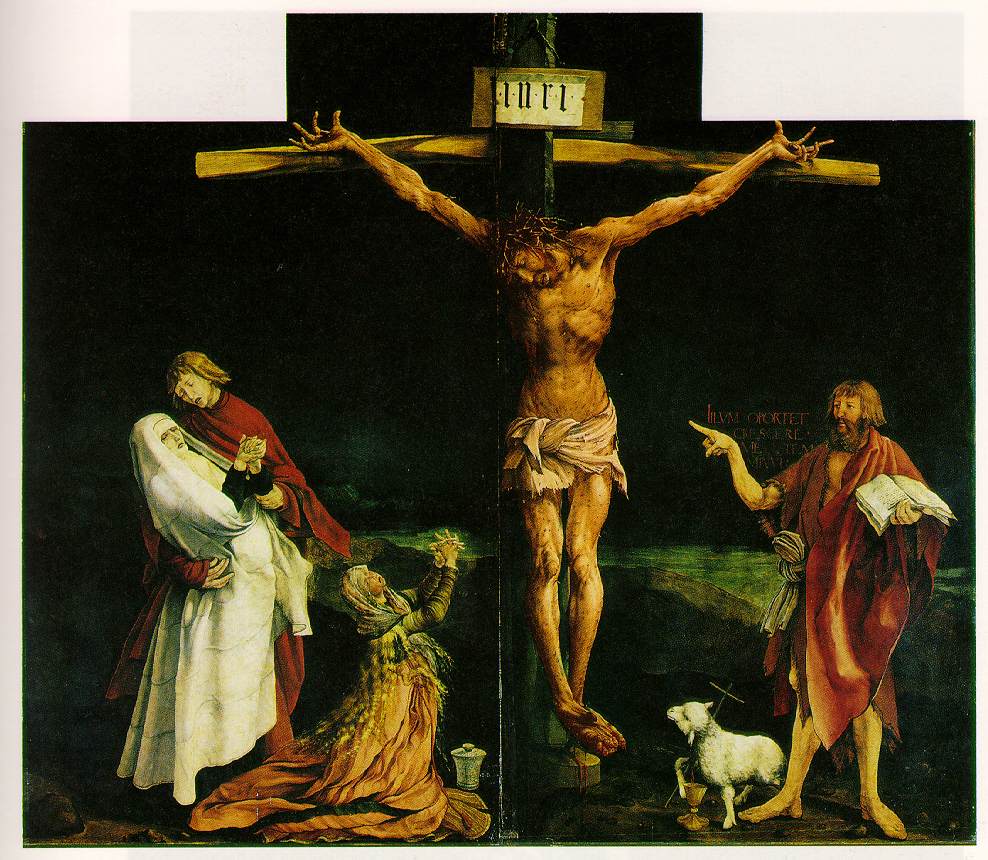
This icon was drawn in the New York of the 1980s (notice the twin towers in the background), and it illustrates Jesus, like the Isenheim altar, as having this physical signs of disease of those who call upon him. AIDS does not usually manifest itself like this anymore - in the scars of Kaposi's Sarcoma. But the image remains powerful.
The Isenheim Altarpiece is an altarpiece painted by the German artist Matthias Grünewald between 1512 and 1516.
By far his greatest, as well as his largest work, it was painted for the Monastery of St. Anthony in Isenheim near Colmar (then in Germany), which specialized in hospital work. The Antonine monks of the monastery were noted for their treatment of sufferers of skin disease, such as ergotism, symptoms of which are displayed by figures including the crucified Christ in the altarpiece.
Underneath the official condemnations, the Roman Catholic church is recognising the contribution that gay people can make
Two days after the 1999 Soho pub bomb, monthly Masses were launched at a Catholic convent in London, welcoming lesbian and gay Catholics, their parents and families. Unable to find a central London Catholic church, after the convent's closure, LGBT Catholics found hospitality at Soho's Anglican parish church. Increasing numbers resulted in the Masses being held twice a month. While the Diocese of Westminster might have believed that the group would fade away, it recognised that real pastoral needs were being met, converts to Catholicism were being made, and a vibrant community could offer something to the local church. In March 2007, Cardinal Cormac Murphy O'Connor invited the Soho Masses LGBT community, in contact with around 300 people overall, to transfer its services to one of Soho's Catholic parishes.
What would Jesus tweet? We're about to find out. Wall Street's Trinity Church, in New York, is to use the microblogging site to recreate Christ's final hours in a Twitter version of the Passion Play. Followers of twspassionplay will get updates from the main characters of the play for three hours starting at 5pm today.
Because I was in the US during the Iraq war, I tend to see more of the positive side of Blair than most people with whom share political views. Apart from Northern Ireland, his government's support for gay rights was quite heroic.
Tony Blair - An Exclusive Interview The Pope is wrong on homosexuality, he says
Tony Blair’s decade in power is seared with disappointments, but there is one cool, consistent success-story that ran through his time in power: the rapid advance of gay rights. If we had known in 1997 we would achieve full legal equality for gay people in Britain – including de facto gay marriage, military service, and a ban on discrimination – so fast and with so little fuss, we would have been startled. When I interviewed the former Prime Minister about gay rights last month to mark the 15th anniversary of Attitude, Britain’s best-selling gay magazine, I glimpsed his very best side – and the strange, gaping blind spots that did so much harm to his record, and the world.
Many financiers have been calling, instead, for a “market solution” based on the so-called Austrian school of economic analysis: the seemingly common-sense view that a crisis created by excess debt cannot be treated with further borrowing but must instead be cured by cutting back inefficient spending and investment and liquidating insolvent businesses, households and banks.
The upshot, in the words of Murray Rothbard, the leader of the Austrian school after the death of its founder Ludwig von Mises, is that “recession is a painful but necessary process by which the market liquidates unsound investments and re-establishes the investment and production structure that best satisfies consumer preferences and demands”.
One does not have to go into the economic details of this argument to see why it makes no sense. Even if Keynes had not refuted the economic logic of the Austrian position back in 1936 in his General Theory, their prescription could never in practice be applied. Since the 1930s, when Andrew Mellon, the US Treasury Secretary, famously urged President Hoover to “liquidate labour, liquidate stocks, liquidate farmers, liquidate real estate”, no other government anywhere in the world has dreamt of doing anything of the kind.
Some politicians, such as Mr Cameron, have toyed with Austrian ideas while in Opposition; others, such as Ms Merkel, have used them as political slogans. But none has come close to putting them into effect. In fact, the strictest proponents of liquidation and austerity in response to financial crises have often presided over the biggest growth of public borrowing.
There are two reasons why austerity never works in response to financial crises — and is never seriously attempted, even by politicians who pay lip service to “liquidationist” Austrian economics or the libertarian market fundamentalism of Ayn Rand.
The first is fiscal accounting. A collapse in economic activity devastates public finances, as we are seeing in Britain today. And once a nation gets into deep deficit, the only way to reduce deficits is to restore economic growth.
Even the most dogmatic theoretical proponents of Austrian economics, once they are put in the practical position of managing public finances, realise that cutting public spending or raising taxes during a recession will dig the public finances into an even deeper hole.
The second and much more important reason why austerity economics has never been tried in practice — at least since the 1930s — is politics.
In democracies, preserving living standards and jobs, protecting savings and keeping people in their houses, take a much higher priority than abstract Austrian arguments against preserving the Austrians’ “unsound production structures” or the burdens of debt on future generations.
And this is also true in dictatorships such as China or prewar Germany, which have generally attached an even higher priority to rapid economic growth and social stability — and have therefore been even more zealous in applying Keynesian remedies for economic downturns.
Politically, therefore, Ayn Rand’s idea of a capitalist economy run on strict free-market principles, with painful recessions allowed to run their course in order to liquidate the excesses of the borrowing booms, is pure self-delusion. Capitalism and private property would be swept away politically long before “liquidationist” economic theories could ever be put into practice.
As chairman of the Federal Reserve, Alan Greenspan was known for using quirky, proletariat metrics to judge the temperature of the economy. The most famous of these, as recounted by NPR's Robert Krulwich in January 2008, were the sales of men's underwear. If the economic scales dipped even the slightest, Greenspan reasoned, it was as sure a sign as any that people were truly feeling the pinch.
'If you look at sales of male underpants it's just pretty much a flat line, it hardly ever changes,' Krulwich recounted after the publishing of Greenspan's book, 'The Age Of Turbulence.' 'But on those few occasions where it dips that means that men are so pinched that they are deciding not to replace underpants. And [Greenspan] said 'that is almost always a prescient, forward impression that here comes trouble.''
Pointless? The editorial board of the National Review, the flagship publication of the American conservative movement, has weighed in on the recent developments on the gay marriage front. As one might expect, the editorial reflects both the factual denialism and the narrow-minded callousness that has come to dominate conservative opinion on this issue. First, the Editors deny that public opinion on gay marriage is changing.
When I commented thus, however, all I go was an error report.
Could we have some discussion of why the British born and residing Viscount Rothermere, owner of the Daily Mail, claims to be non-domiciled for tax purposes, and runs the Daily Mail's profits through off shore trusts so as to avoid tax?
I mean, that seems more important than Moobs?
what do no Tory bloggers pick up on what Private Eye has been publishing for weeks?
As Ben Macintyre writes today, The Great Escape is probably the best-known example of a Hollywood habit which has infuriated Brits almost since the war ended - hijacking engagements involving British, Indian or Commonwealth troops to make Americans into the heroes.
This is just The Times being silly.
Of course only the US fought alone in WWII, the USSR provided no help at all, Americans decoded German submarine codes.
I don't see why the imprudent are more deserving of our intervention than the prudent?
I don't think Capitalism rewards the prudent and imprudent, it rewards the lucky and punishes the unlucky.
As I have said elsewhere, I am on the side of the "runts".
2.
You're proposing the replacement of markets by computerised economic planning, aren't you?
I am suggesting that this is already happening, that is its taking place in the private sector just as much as the public sector. In fact, it's being pushed by private companies who as institutions - unlike banks - have no intrinsic desire to see "free markets." While I have some real reservations about privacy, I don't thing this is a bad thing.
3.
Austrians are betting that, on the whole, (a) he will guess what will increase his utility more often, more accurately than would a government-agent or computer making the choices for him, and (b) that even if he were so useless that an agent could make better choices for him, he would value his freedom sufficiently to prefer to make his own mistakes than have them made for him.
This may or may not be true. It's a metaphysical rather than a scientific statement.
***
Personally I think markets are destructive of happiness and the environment. They tread on families and create false ideas about status and wealth.
Once the world can been organized in such a way - by IT if necessary - that everyone is fed, clothed, housed, given medical treatment, and access to education in a sewage-free sustainable world ecology. If all that can happen, I am then quite prepared to let some people choose between Prada and Versace handbags.
Until them, I think a well planned economy will produced the shared wealth better.
Amid news of a calamitous fall in industrial production and improbably premature claims of green shoots of recovery, siren voices are warning against any further spending boost in this month's budget. Short of much else useful to say about the crisis, David Cameron's Tories are clamouring for cuts - starting with the pay of nurses, teachers, firefighters and other public sector workers who, as we are now led to believe, have been living the life of Riley while the corporate world has scrimped its way through the New Labour years.
BAGHDAD — The relative freedom of a newly democratic Iraq and the recent improvement in security have allowed a gay subculture to flourish here. The response has been swift and deadly.
In the past two months, the bodies of as many as 25 boys and men suspected of being gay have turned up in the huge Shiite enclave of Sadr City, the police and friends of the dead say. Most have been shot, some multiple times. Several have been found with the word “pervert” in Arabic on notes attached to their bodies, the police said. ... In recent months, groups of gay men have been taking greater chances, gathering in cafes and other public places in Baghdad, Basra, Najaf and other cities. On a recent night in Sadr City, several, their hair parted down the middle, talked as they quietly sipped tea at a garishly lighted cafe, oblivious to the stares of passers-by.
Basim, who would not give his last name out of fear for his safety, said he knew at least 20 young men from Sadr City’s large but hidden gay community who had disappeared during the past two months. He said he had learned later that each was found dead. After three of his friends were killed, he stayed inside his house for a week. Recently he has begun to go out again.
“I can’t stay at home all day,” he said. “I need to see my friends.”
Publicly, the Iraqi police have acknowledged only the deaths of six gay men in the neighborhood. But privately, police officials say the figure is far higher.
Libraries and archives from around the world have come together in a project to share their collections of rare books, maps, films, manuscripts and recordings online for free. ... As well as documents and recordings, the digital archive will also feature videos from curators explaining why they are important and what they reveal about a culture, and the option to translate material into different languages. Users will be able to browse and search by place, time, topic and type of item, with material to also include musical scores, prints, photographs, architectural drawings and other significant cultural materials.
For 30 years our democracies have offered only one vision: a society governed by markets and profit. We are making a new politics of the democratic left in Europe.
One of my correspondents (RG Prior) responded to an earlier post on money.
You don't appear to provide any reason to disregard Austrian economics, or to dismiss Mises.
Well, I think it is inhuman in the political policies it promotes, fails in understanding humanity, and fails even to understand that its practical proponents (i.e. conservative politicians) will not hold to such non-populist policies.
This, and the suggestion that IT systems will be able to read people's minds and predict the impact of innovation within 10 years sufficiently accurately and frequently that they will enable effective economic planning and the ditching of markets, indicates that you put dogma ahead of reason.
Not really, because I am in fact worried about the sheer amount of individual tracking that goes on already in our economies. In other words, not dogma, but reasonable prediction.
But, first of all, on the harder question. There is less and less social science proof that people have individual free will. Even if they do, the variety of what is willed is within very narrow limits. I agree that people may naturally have a higher choice range than older soviet central planning could account for, but on a mass level RFIDing goods, tracking credit card spending, etc. is giving organizations like Walmart an essentially "planned" approach to its internal economy. Hell, we even know people will buy more iced yogurt if it's placed in the middle shelf of the last aisle in a supermarket.
I think these IT changes already well under way, will make talk of "reading peoples minds" irrelevant. IT will not read people's minds, it will predict their economic behaviour.
In other words I think the economic calculation problem will be solved by modern IT (and its predictable developments) in a way that makes the eighty-year old theories of Mies and Hayek just a matter of historical interest.
I'll tell you what. 10 years is soon enough that there's a decent chance both of us will still be alive. What shall we wager that IT systems with those capabilities are ubiquitous within that period?
Of course, we will need to come up with some tests by which this can be judged. Something like the Turing test, but demonstrating mind-reading and predictive capabilities rather than the ability to convince a human of the respondent's humanity?
Well since, by my current calculation I have been HIV+ since 1985, I really doubt I will be around ten years hence.
But we will see in any case that I am not predicting mind reading technologies within ten years. I think such technologies will be available in 30 years or so, and I find that quite as frightening as anyone else.
BREAKING: Moments ago, the Vermont House voted 100-49 to override the marriage bill veto! The House vote, which followed the Senate voting 23-5 this morning to override Gov. Douglas’s veto, means that Vermont becomes the first state to OK marriage equality through the legislative process.
Today Vermont joins Massachusetts, Connecticut and Iowa in allowing gay and lesbian couples to legally marry.
This has been an amazing week for advances in marriage equality for lesbian and gay people.
*Two US states have legalized same sex marriage (Iowa by judicial decision, Vermont by super-majorities overriding a veto in both houses of its legislature). *Washington DC has agreed to recognize same-sex marriages performed in other states. *Sweden has legalized same-sex marriage (by legislative action).
That's four political units in one week.
At this stage, we need to campaign for full marriage equality in the UK.
Obama Derangement Syndrome By David Horowitz FrontPageMagazine.com | Monday, March 30, 2009
I have been watching an interesting phenomenon on the Right, which is beginning to cause me concern. I am referring to the over-the-top hysteria in response to the first months in office of our new president, which distinctly reminds me of the “Bush Is Hitler” crowd on the Left.
Speaking of this crowd, have you seen any “I am so sorry” postings from that quarter as Obama continues and even escalates the former president's war policy in Afghanistan and attempts to consolidate his military occupation of Iraq?
One of Spain's most enduring historical mysteries is close to being solved as experts decipher and translate more than 10,000 Arabic inscriptions adorning the walls of the Alhambra palace in Granada.
The intricate Arabic inscriptions carved into the ceilings, columns and walls inside the imposing hill-top fortress have long fascinated visitors. They contain everything from snatches of poetry and verses from the Qur'an to clever aphorisms, pious wishes and boastful slogans.
There are so many of them, however, that nobody has ever managed to study each and every one. Now a team of researchers armed with 3D laser scanners and digital imaging software is slowly working its way around the complex recording, transcribing and translating every inscription.
Below: 1) Sebastian Grigg 2) David Cameron 3) Ralph Perry Robinson 4) Ewen Fergusson 5) Matthew Benson 6) Sebastian James 7) Jonathan Ford 8) Boris Johnson 9) Harry Eastwood
Bullingdon Club dinners were the occasion of a great display of exuberant spirits, accompanied by a considerable consumption of the good things of life, which often made the drive back to Oxford an experience of exceptional nature". A report of 1876 relates that "cricket there was secondary to the dinners, and the men were chiefly of an expensive class". The New York Times told its readers in 1913 that "The Bullingdon represents the acme of exclusiveness at Oxford; it is the club of the sons of nobility, the sons of great wealth; its membership represents the 'young bloods' of the university". ... The Club's modus operandi has often been to book a private dining room under an assumed name, as most restaurateurs are wary of the Club's reputation for causing considerable drunken damage during the course of the dinners. However, it depends on the character of the membership at the time — which necessarily varies from year to year — whether the famous 'destruction' is an intentional act of wanton vandalism or a side-effect of drinking prodigious quantities over a lengthy period of time.
I think the language of "aspiration" is as pointless as the language of "stakeholders."
Sure we should make sure social mobility is possible, but in any society there will be some sort of Bell Curve of social position, and if for some "social mobility" is up, for others it will be down.
I happen to think general IQ measures something real. I do quite well in such tests. But I have to admit I do less well in "Emotional Q" and "Artistic Q". Value in society must derive from some combination of them all.
But if we accept general IQ as real, then we need to face the fact that, by definition, half the population has an IQ of 100 or less.
Our goal should be a society in which all people, of levels of ability can live satisfying lives, and not one where people are driven crazy "aspiring" to things they cannot every really achieve nor which will make them happy.